
Opinion

Greater Head Start flexibility will empower program leaders
Alex Adams, Assistant Secretary of the Administration for Children and Families at the U.S. Department of Health and Human Services, and Lizbeth Casbo White, Director of the Office of Head Start, co-authored an article emphasizing that the core of Head Start programs lies in local workers. They argue that federal policy should trust local leadership by reducing top-down directives and leveraging existing state-level regulations to grant greater flexibility to more than 1,600 local grantee agencies nationwide. The article responds to critics, noting that flexibility does not mean weakened accountability, and cites data showing that from fiscal years 2022 to 2024, funded Head Start slots decreased by 97,625 while federal spending reached record highs, calling for results-oriented reform.

Miami-Dade eliminated free school meals. They won’t be the last.
Due to federal nutrition assistance cuts under the One Big Beautiful Bill Act, Miami-Dade County public schools' CEP eligibility has declined, leading to the termination of district-wide free school meals starting August 2026. Approximately 218 schools will lose this benefit, affecting over 173,000 students, with families facing annual meal cost increases of up to $2,412.

A way forward beyond America’s education stalemate
American public education has long been mired in ideological debates, while Texas, through the Texas Partnerships Act (SB 1882) enacted in 2017, encourages school districts to partner with charter school operators to improve persistently failing schools. This model preserves the public nature of schools but transfers operational authority to entities with a clear improvement mission. This article analyzes the operational principles of this framework, its demonstrated results, and recommends that federal policy explicitly recognize such partnership models under the Every Student Succeeds Act, while strengthening independent research to encourage more states to adopt them.
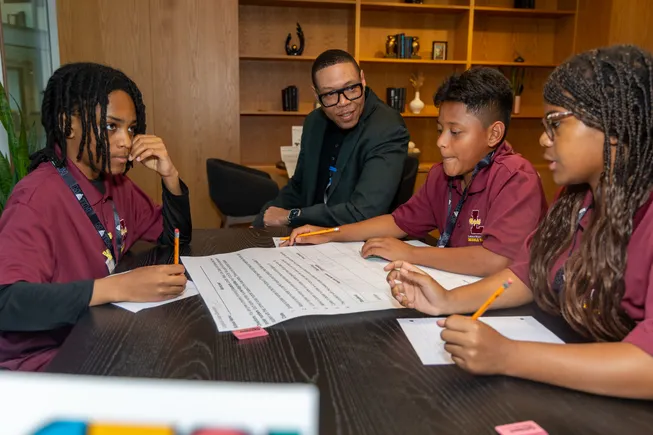
DC Public Schools leads nation in academic recovery. Here’s why.
Researchers from Harvard, Stanford, and Dartmouth found that D.C. public schools led the nation in English and math academic recovery between 2022 and 2025. Chancellor Lewis Ferebee explains: competitive pay to retain teachers, sustained investment in high-impact tutoring, early adoption of the science of reading, and an anonymous $20 million donation to accelerate math initiatives together form the engine of this recovery.

Why access to STEM must include students who learn and think differently
Professor Kara Ball points out that STEM education should not exist solely as an elite program but should be integrated into general classrooms through neuro-inclusive design. She shares her experience of using the $5 million award from the Bezos Courage and Civics Prize to support Understood.org in promoting inclusive STEM practices, and calls on school districts to invest in teacher support, choose inclusive materials, and build partnerships.

How should HR handle politics in the workplace?
Employee political speech and activities may cause workplace conflicts, but private employers' handling authority is subject to multiple legal restrictions. This article outlines relevant legal standards and provides actionable balancing strategies for HR.

Learning the reason behind students’ struggles sets them up for testing success
This article, written by Rudy Sandoval, principal of Montara Elementary School in California, explores how to improve academic performance by deeply analyzing the reasons behind student errors rather than focusing only on surface symptoms. It describes the school's practice of using a data platform and professional learning teams for teachers to significantly raise sixth-grade state test scores within one year, emphasizing that education should focus on continuous growth rather than short-term scores.

Uncertainty is the new normal in education. Here’s how leaders can protect classrooms.
Uncertainty has become a key word in U.S. education. Former AASA Executive Director Dan Domenech, drawing on his own experience, proposes that education leaders should safeguard classrooms amid federal policy fluctuations by prioritizing needs, protecting teachers, adopting results-oriented contracts, and engaging in multi-scenario planning.

For students with disabilities, the Office for Civil Rights is often the last line of defense
The U.S. Department of Education's Office for Civil Rights (OCR) faces the threat of being consolidated into the Department of Justice, which could sever critical protections for students with disabilities, especially those at the intersection of race, poverty, and disability. The OCR not only handles individual case complaints but also drives systemic reforms and collects national civil rights data. Drawing on nearly two decades of experience, the author explains the functional differences between the OCR and the Department of Justice, warning that a merger would reverse fifty years of progress and leave students with nearly 25,000 pending complaints without recourse.

How can we create the conditions to inspire young leaders to say ‘yes’ to teaching careers?
Facing teacher shortages and Generation Z's new expectations for careers, the education sector is exploring redesigning teacher roles. This article uses Arizona State University's team teaching model as an example, highlighting its potential to enhance teacher autonomy and retention, and mentions a pilot program in the San Francisco Bay Area.