
Ten Commandments Display Mandates Head to Supreme Court as Families Seek Definitive Ruling
Texas families have filed a joint petition with the U.S. Supreme Court seeking review of lower-court rulings that upheld state laws mandating Ten Commandments displays in public school classrooms. The cases, Nathan v. Alamo Heights Independent School District and Cribbs Ringer v. Comal Independent School District, ask the justices to determine whether such laws breach the First Amendment's establishment clause and parents' free exercise rights. The high court may accept or decline the cases, which mirror disputes arising from similar statutes in Arkansas, Louisiana, and Alabama.
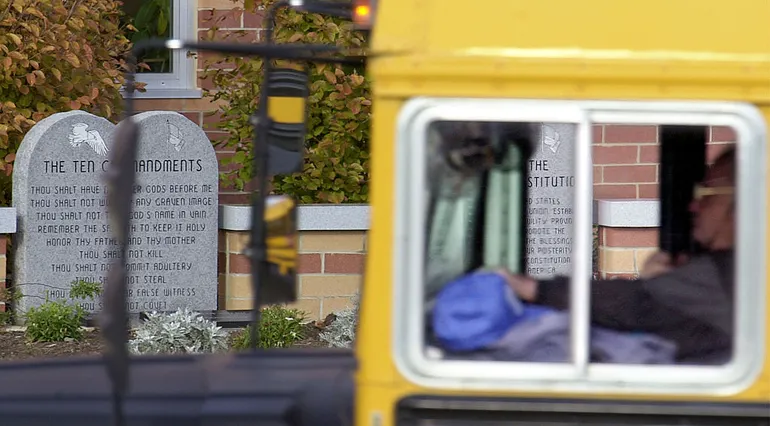
Dive Brief:
- The constitutionality of state laws requiring school districts to display the Ten Commandments could receive a definitive ruling, as two prominent challenges were appealed to the U.S. Supreme Court on Monday.
- Texas families filed a joint petition in Nathan v. Alamo Heights Independent School District and Cribbs Ringer v. Comal Independent School District, asking the justices to decide if Ten Commandments laws violate the First Amendment's establishment clause and parents' rights under the free exercise clause to direct their children's religious upbringing.
- The high court could choose to accept or reject hearing the cases, which are similar to others that have emerged in response to such laws in four states.
Dive Insight:
Since 2021, some 82 bills have been proposed or passed in 26 states relating to the Ten Commandments in schools in some way, marking a “sharp uptick” in the years following, according to an analysis provided to K-12 Dive by Jennifer Thomsen, principal and researcher for Education Commission of the States, earlier this month.
Of those, nine bills related to displays or student instruction on the Ten Commandments in public school classrooms have reached a governor’s desk. Eight were signed into law, and one, in Arizona, was vetoed.
Arkansas, Texas, Louisiana, and Alabama — where such a law was enacted most recently and is set to take effect in January — are the four states requiring displays of the religious text in schools.
Louisiana was the first state in recent history to adopt a Ten Commandments law in 2024, after which legal challenges quickly spread questioning the constitutionality of these mandates and seeking to stop their implementation.
In the Texas cases, for example, families including Hindu, Jewish, Christian, nonreligious, and other faiths from across some 22 districts say the Protestant King James Bible version of the Ten Commandments required in every Texas public school "will pressure their children to observe, meditate on, venerate, and follow the State’s favored scripture, and to suppress their own religious or nonreligious values and beliefs at school."
So far, such lawsuits have often been unsuccessful in stopping the displays.
Supporters of the laws say students should know the Ten Commandments because of their influence on the nation's Founding Fathers, and their influence on history and literature as a result.
The petition filed Monday against the laws also referenced many Texas lawmakers who said they hope students will "know about God" and introduce children to "eternity with God."
"Left standing, this reasoning could empower government officials to flood public-school classrooms with an endless array of religious rules, instructions, and mandates," the petition said.
Plaintiffs said the lower courts' decisions to let the Texas Ten Commandments law stand violates recent and decades-old Supreme Court precedent established in Stone v. Graham in 1980 and Mahmoud v. Taylor in 2025. The Graham case struck down a similar law in Kentucky, and the Mahmoud case gave parents the right to opt their children out of certain instructional materials.