
K-12 School Districts Enter the Post-ESSER Era: Fiscal Realities and Responses After Federal Pandemic Funding Ends
Multiple education finance and policy experts say that the historic influx of federal funds used to help K-12 schools recover from setbacks caused by the most severe global pandemic in modern times has so far been largely spent without waste or fraud and has been crucial to students' academic recovery. Experts say concerns about dramatic and widespread fiscal cliffs for school districts after most flexible federal COVID-19 emergency funds dissipate also appear to be exaggerated.
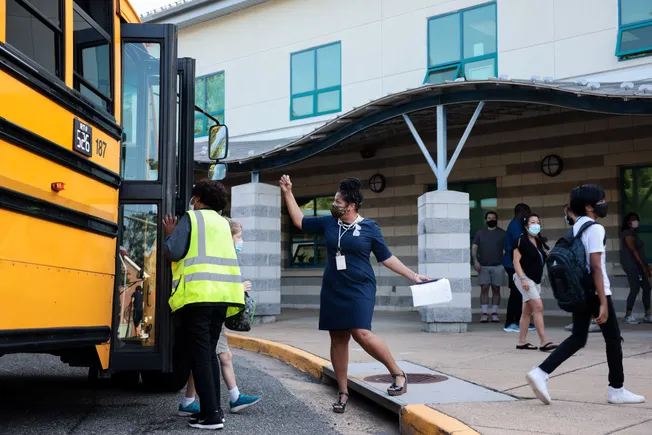
Historic federal funding injected to help K-12 schools recover from the worst global pandemic in modern history has largely been spent so far without waste or fraud. Multiple education finance and policy experts say the money has been crucial to students' academic recovery.
Experts also believe that as most of the flexible federal COVID-19 emergency funds phase out, earlier fears that school districts would face a severe and widespread "fiscal cliff" appear to have been exaggerated.
"I think it's not as bad as people feared, because there was a narrative for a while—you would have thought every district was going to face a cliff—and the reality is that not all districts are," said Eleka Yost, director of advocacy and research at the Association of School Business Officials International.
Pandemic funding's positive outcomes and lingering challenges
Jasmine Bolton, policy director at the Partnership for Learning Futures, said federal pandemic funding helped school districts support students with disabilities, make progress in narrowing racial equity gaps, and invest in whole-child supports. The nonprofit has a network of more than 800 stakeholders in education. "I think we have to emphasize the magnitude of this funding, the depth of its impact, and that its impact is still ongoing," she said.
Although pandemic funding supported many positive initiatives, Yost, Bolton, and others noted that four years after the pandemic first broke out, as schools gradually move away from federal emergency funds, the challenges school districts now face remain.
Some school communities are facing hiring freezes, school consolidations, and necessary facility improvements, while continuing to meet students' mental health and academic needs.
"We need sustained investment, and likely sustained investment targeted at what students are still experiencing as a result of the pandemic," Bolton said.
Saying goodbye to ESSER: Key dates and funding scale
The last and largest of the federal COVID-19-related funds—American Rescue Plan money distributed through Elementary and Secondary School Emergency Relief—has an obligation deadline of September 30, by which school districts must commit to spending the funds. The districts' ESSER-ARP spending deadline is January 28, 2025.
ESSER funds allocated under the Coronavirus Aid, Relief, and Economic Security Act and the Coronavirus Response and Relief Supplemental Appropriations Act had earlier obligation and spending deadlines. However, some districts that received spending extensions have longer spending timelines.
ESSER funds total $189.5 billion. By comparison, Congress appropriated $79.1 billion to the U.S. Department of Education for fiscal year 2024. Any unused pandemic relief funds must be returned to the Department of Education.
"I think we have to emphasize the magnitude of this funding, the depth of its impact, and that its impact is still ongoing." —Jasmine Bolton, policy director at the Partnership for Learning Futures
Orderly phase-out: Historical lessons and planning ahead
Because the obligation and spending dates were set when Congress approved K-12 pandemic relief funds in 2020 and 2021, school districts were able to plan a timely exit path for the funds. Districts were also warned to avoid unsustainable spending practices—such as hiring large numbers of additional full-time staff—that would be difficult to maintain once federal funds ran out.
Noelle Ellerson Ng, associate executive director of advocacy and governance at AASA, The School Superintendents Association, said lessons learned from the 2009 American Recovery and Reinvestment Act—which helped states and localities overcome the Great Recession—also prompted school systems to exercise discipline in using pandemic funds.
One lesson, she noted, was to avoid using aid funds for recurring personnel costs that might not be sustainable after the funding ends.
"People have enough memory to think, 'Okay, look at what happened to schools after ARRA went away,' and they were better able to anticipate and respond to what that funding reduction might bring," Ellerson Ng said.
Still, adjusting to budgets without ESSER support will remain a challenge for many school systems, especially in low-income areas that received higher proportions of federal emergency aid.
 A bottle of hand sanitizer sits next to Play-Doh containers at Byck Elementary School in Louisville, Kentucky, on March 12, 2021.
Jon Cherry/Getty Images
A spring survey by the Texas Association of School Business Officials showed that of 313 school districts surveyed, 43% said they were implementing significant budget cuts. More than half of the districts expected to end fiscal year 2024 with a deficit.
"I think there's a general willingness to acknowledge, 'Listen, these services or supports were brought in because there was federal funding, and when the federal funding goes away, something has to go with it,'" Ellerson Ng said, adding that discussions about which programs to streamline or cut can be difficult at the local level.
Spending progress: Significant variation across states
A Department of Education dashboard on ESSER spending progress shows that as of June 30, spending rates among state school districts ranged from 70.5% (Nebraska) to 93.1% (Washington state). The District of Columbia was an outlier, with a spending rate of 63.5%.
Marguerite Roza, director of the Edunomics Lab at Georgetown University's McCourt School of Public Policy, said most school districts will use all their funds, but some will not. As the ARP spending deadline approaches, she recommended that state education agencies monitor districts' liquidation progress to ensure funds are used rather than returned to the federal government.
Roza noted that the type of spending also matters. For example, schools cannot use ESSER funds to pay staff salaries after the obligation deadline. She said that under education finance provisions that existed before ESSER, only vendor contract expenditures for services or materials can extend beyond the obligation deadline.
According to the Center on Budget and Policy Priorities, based on state-reported data, nearly 50% of ARP funds were used for workforce costs, such as hiring teachers, reading specialists, and providing salary increases.
"The key is efficiency. We have to use existing resources better to maximize value and cut what doesn't work." —Marguerite Roza, director of the Edunomics Lab
Although the Department of Education has created pathways for states and districts to apply for pandemic relief spending extensions, the application process can be complex. Some states, such as Minnesota, have discouraged districts from seeking spending extensions.
According to the Council of Chief State School Officers, an organization of top state education officials, some auditors have expressed concerns about the late liquidation process due to the complexity of federal and state education finance rules. The Department of Education said it will ensure auditors understand its guidance and will answer questions from states and auditors.
The Department of Education's Office of Inspector General is reviewing how some local and state entities used and planned ESSER funds and has found most to be in compliance with allowable requirements.
Yost said grant managers, district chief financial officers, and district finance teams "really want to do right by kids. They really want to make sure these funds reflect the good news and help students not only address pandemic challenges but recover and get on a better path afterward."
Efficient budgeting: A data-driven post-ESSER transition
Yost said that while a severe and widespread fiscal cliff is unlikely as ESSER funds phase out, many districts will experience a fiscal downturn, prompting school systems to adapt to the post-ESSER reality.
Roza said school finance decisions should be guided by data analysis to determine which investments are helping students academically and socially—and which are not. For example, if math scores are low, schools should prioritize retaining math instructional investments and consider cutting costs in other areas.
"Districts are going to have to think differently about compensation in the future, because if they're trying to shrink their workforce, they shouldn't be doing across-the-board raises in the name of retention," Roza said. She said raises for retention purposes should target hard-to-staff positions, such as math, special education, and high-poverty schools, or areas with significant academic needs.
Similarly, Roza said if districts face financial decisions that include closing or consolidating schools, those decisions should be based on cost and performance data.
"If you're going to downsize, in most industries, you typically look at performance first, try to keep what works, and cut what doesn't," she said. "So we encourage district leaders to be highly vigilant about that."
Roza added: "The key is efficiency. We have to use existing resources better to maximize value and cut what doesn't work."