
US school districts introduce AI security screening equipment to prevent campus gun incidents
In response to frequent campus gun incidents, school districts such as Charlotte-Mecklenburg in North Carolina, USA, have introduced AI weapon detection systems. Supporters claim they are efficient and non-invasive, but security experts warn that the technology is not yet mature and faces issues of false alarms and privacy controversies.
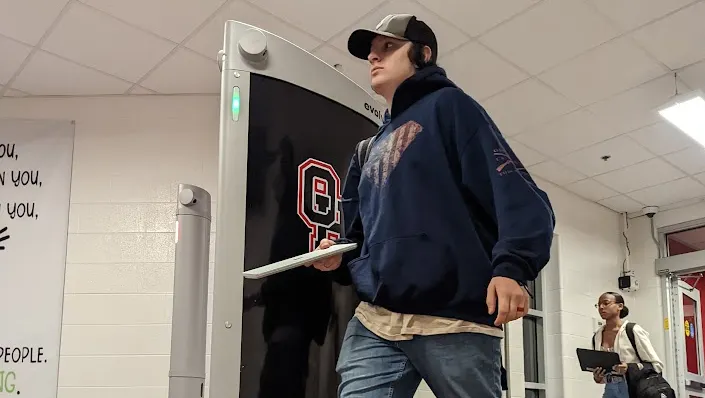
During the previous school year, the number of guns found on campuses in the Charlotte-Mecklenburg Schools district in North Carolina continued to rise, prompting the district and school administrators to consider adding security measures such as metal detectors and transparent backpacks.
However, the district's Chief Operating Officer, Brian Schultz, realized the critical missing link in preventing guns from entering schools while visiting the Carolina Panthers football stadium. He noticed the convenient process used to screen spectators at the stadium.
Shortly after Schultz's visit, the district's police chief and board of education members also visited the stadium to observe the security screening operations in person.
These security screening devices come from Evolv, a security technology company headquartered in Massachusetts. The system uses digital sensors and artificial intelligence to identify concealed weapons. The devices are placed at entrances, and visitors walk between pillars connected to AI, which can distinguish most everyday items carried on a person from weapons. The system generates a digital image indicating the weapon's location on the body (such as in a pocket or backpack) and sends a threat alert to staff.
Proponents of the technology say this AI-assisted screening is faster, less invasive, and more accurate than traditional security checks becausethere is no need to open bags for inspectionor conduct pat-downs.
The Charlotte-Mecklenburg district ultimately decided to install the technology in schools, with one of the main reasons being the speed of the security screening. High schools have about half an hour before the first class, needing to get thousands of students and staff through the school gates. Schultz said, "We want to maintain this pace to avoid impacting instructional time."
Similar to Charlotte-Mecklenburg, other districts are also exploring or adopting AI-assisted campus safety measures. However, some have expressed skepticism and advised caution.
"With every incident, the alarm is raised faster, especially when they occur in quick succession. This brings political issues and pressure, leading to a panic mode, and vendors are already at the door ready to solve your problem."
— Kenneth Trump, President of National School Safety and Security Services
Kenneth Trump, president of the consulting firm National School Safety and Security Services, said that since the end of the 2021-22 school year, the influx of AI security technology into school districts has been noticeable, especially after more high-profile or multiple gun incidents on campuses.
"With every incident, the alarm is raised faster, especially when they occur in quick succession. This brings political issues and pressure, leading to a panic mode, and vendors are already at the door ready to solve your problem," Trump said.
But he cautioned that it is unwise for district leaders to make large investments in campus safety technology under pressure. "When there is intense political pressure on the school community, it is the worst time to make major changes to school safety policies and practices," Trump said.
Despite the rapid development of the AI field, Trump believes the technology is still in its infancy for school safety. In fact, he does not recommend that districts use this technology.
"Schools are becoming testing grounds and new foundations for these companies to build AI. The more the system is used, the smarter it gets," Trump said, "Therefore, those who are the first to use this technology in schools will encounter vulnerabilities, limitations, malfunctions, errors, and false alarms, and their children and schools are being used to make vendors' AI software smarter."
Impact of the Uvalde Incident
Sincethe tragic mass shooting at Robb Elementary School in Uvalde, Texas, AI technology has increasingly been integrated into campus safety systems across the country.
Mike Ellenbogen, founder and Chief Innovation Officer of Evolv, said Evolv's technology is one example. According to company emails, Evolv currently works with 377 schools or districts nationwide, using AI to scan 300,000 students weekly.
"School deployments are certainly accelerating," Ellenbogen said, "The reality is—this is an event-driven industry."
Ellenbogen said the AI technology used by Evolv does not collect personally identifiable information of people passing through the sensors. When a person walks through Evolv's sensors, their body "looks like a bag of saline" in the system. Only when a potential weapon is detected and an alert is triggered does the system take a photo, allowing monitoring personnel to identify the person carrying the suspicious item.
"We are very aware of the bias issues that AI training can bring, but this does not apply to our work because we do not use video or facial recognition for core detection," Ellenbogen said.
The technology is also "continuously improving" in detection capabilities and reducing false alarm rates.
"I would say we are in the early stages of this race, and in the future, we will continue to explore other technologies to enhance the capabilities of the Evolv Express system," he said.
Another company bringing AI technology to campus safety is SparkCognition, which uses AI to monitor surveillance camera feeds, such as notifying relevant personnel when a gun is detected. The company's Chief Marketing Officer, Stephen Gold, said the company serves about 100 school districts across multiple states.
While such AI security technology has been used in various fields for years, companies like SparkCognition are just beginning to sell to schools. Gold said interest in the technology in the education sector has grown "incredibly."
"Of course, the Uvalde incident brought this issue back into focus," Gold said, "But gun violence on campuses is becoming more frequent, and I think that alone is enough to raise awareness."
According to a 2022 analysis by market research and consulting firm Omdia, the U.S. education security equipment and services market was estimated to exceed $3.1 billion in 2021, covering public and private K-12 and higher education institutions. The firm expects the market to grow at an annual rate of 8%.
Omdia senior analyst Bryan Montany said most of the growth is expected to come from upgrades to technology-based systems and services. Additionally, based on data collected in 2022, nearly 90% of U.S. schools use video surveillance systems covering at least part of their facilities, and almost all schools control building access through door access systems.
Rising Number of Guns on Campus
Charlotte-Mecklenburg Schools, with 142,000 students, adopted Evolv technology at school entrances in March 2022, initially covering seven large comprehensive high schools. By the end of the 2021-22 school year, the technology had been deployed to 21 high schools. As of January 2023, scanners were installed in 68 schools, including all middle schools, high schools, and K-8 schools, as well as some smaller magnet high schools. Schultz said the district has a total of 181 schools.
Schultz said that between August and December 2021, before the scanners were installed, the district recorded 22 gun incidents on campus—more than the entire previous school year. "This was very alarming," he said. One of the guns accidentally discharged during a student conflict, but no one was injured. By the end of the 2021-22 school year, the district had found a total of 34 guns on campus that year.
Schultz said that while Charlotte-Mecklenburg had emergency preparedness and safety protocols, it was not actively screening for guns at the time. When schools resumed in-person instruction after the pandemic, the district, like others nationwide, noticed an increase in physical assaults among students and people bringing guns onto campus.
According to the K-12 School Shooting Database, the United States experienceda record number of school shootings in 2022. Database founder David Riedman told K-12 Dive in December 2022 that school shootings occurred on "almost every school day" in the fall of 2022.
Additionally, data collected by Riedman shows that most school shootings last year involved student shooters. In 2022, there were more school shootings committed by students aged 10-18 than in previous years.
In the first 35 days of 2023, the database recorded35 school shootings。
Phased Implementation
Charlotte-Mecklenburg Schools took a phased approach to deploying scanners, prioritizing the first seven devices at schools more likely to have gun incidents based on five years of data.
Schultz said these seven schools had higher proportions of low-income and marginalized students, a decision that drew criticism from some in the community. In the next phase, the district included schools with diverse student demographics and sizes.
Before implementation, the district reviewed safety policies and procedures, consulted lawyers, and developed staff training. The district worked with its communications team to create talking points for principals, videos for community members, and a student orientation process to familiarize everyone with the new scanners.
Schultz said the cost of using the technology at 68 schools is approximately $15 million over four years. The district applied to use federal COVID-19 funds to share the cost but was denied by the state. The expenses are covered through multiple funding sources, including the district's capital fund and state and local resources.
Schultz said $15 million sounds high, but spread across about $220,000 per school, or about $214 per student in grades 6-12, it is reasonable. "When you think about saving students' lives, it's a small price to pay," Schultz said.
From the start of this school year through January 27, the scanners identified three guns on campus—two from students and one from an adult—and staff successfully confiscated the weapons without incident.
"It's About Caring for Each Other"
In the spring of 2022, Hopewell High School became one of the first schools in Charlotte-Mecklenburg to install the technology. Principal Tracey Pickard described the school of 1,800 students as diverse and closely connected with students and families.
Therefore, finding guns on campus twice in 2021 shocked her. "It was clear we had to take measures to stop students from thinking they could casually bring weapons to school," Pickard said.
To prepare for the AI weapon detection technology, the district provided guidance on the new entry process and coordinated with the district to communicate information to the community.
Additionally, Pickard invited parents to a Q&A session about the new protocols. A small group of parents visited the school to see the system in operation and then helped communicate to other parents why the school was taking this measure.
The school also provided information and training to staff and formed a staff leadership team to help answer colleagues' questions about the new system.
There was an adjustment period when the system was first launched. Certain combinations of notebook binders, water bottles, and umbrellas would trigger Evolv scanner alerts.
Students also had to hold their Chromebooks while passing through the scanners. Evolv's Ellenbogen explained that certain models of Chromebooks have weapon-like features that can trigger some Evolv scanners. He added that the detection algorithms of the Evolv Express system are continuously being optimized.
Pickard said that as everyone has become familiar with the entry screening process, it now runs more smoothly.
The principal said she has learned a lot about campus safety over the past year, but more importantly, she has realized that students and the broader community want schools to be transparent about security threats and solutions.
Before installing the scanners, she was reluctant to discuss campus security threats with students because she did not want to upset them. "But it was the opposite," she said, "They want me to talk about it, to make it clear that 'this is not acceptable at our school. This does not define us, because we are Titans.'"
"We care about each other, and if there is a problem, if we see something, we speak up," Pickard said, adding that the scanners are just one part of creating a safer campus.
"It's about caring for each other and maintaining an environment where we keep each other safe," Pickard said.
Beyond Gun Detection
Schultz said that since the devices were installed at 68 schools, there has been a decrease in guns found on campus as well as other prohibited items such as e-cigarettes, drugs, knives, and stun guns.
For example, in the second quarter of the 2021-22 school year, there were 94 incidents of weapons other than guns found on campus districtwide. In the second quarter of this school year, such incidents were 40, Schultz said.
"This is a community, state, and national issue, and we are all exploring solutions in the best interest of students."
— Tracey Pickard, Principal of Hopewell High School
But Schultz, Pickard, and others all said schools cannot rely solely on weapon detectors to ensure safety.
Schultz suggested that school systems, when exploring safety measures, should convene community members to discuss proactive approaches to preventing school violence. He also recommended learning from other school systems.
Pickard also agreed that consulting with other schools on safety solutions is helpful. "We realized we are not alone," Pickard said, "This is a community, state, and national issue, and we are all exploring solutions in the best interest of students."
Pickard advised school leaders not to take campus safety challenges personally. "You have to put aside your pride and work with people in the district," Pickard said.
Creating a Welcoming Environment
Jill Lemond, Director of Education at Evolv, said campus safety must take a layered approach, including strong security protocols and a school culture built on trust and open communication.
Lemond knows the importance of community engagement and collaboration on campus safety issues. In November 2021, when she was Assistant Superintendent of Student Services at Oxford Community Schools in Michigan,a student shot and killedfour classmates and wounded seven others.
Lemond said schools should focus on strategies, including weapon detection, to prevent guns from entering campuses. At the same time, it is also necessary to prioritize involving staff and the entire school community, including students, in discussions on how to make schools safer.
Lemond added that school schedules should allow time for teachers and administrators to connect personally with students. Building trust helps students feel more comfortable sharing information about potential threats.
"We need to get back to basics," Lemond said, "Let's make eye contact, say and remember their names. Welcome them into the campus environment every day, because the only thing that can stop a school shooting is kids not wanting to shoot the people at their school."
Disclosure: Omdia and K-12 Dive are both part of Informa Group. Omdia has no influence over K-12's reporting.


