
Home Visits: The Emotional Bond Connecting Educators and Families
Home visit programs help educators and families build trust through core practices such as voluntariness, training, and focusing on hopes and dreams. Data shows that schools implementing home visits systematically see improved student attendance and academic performance. This article shares stories of multiple educators and parents, illustrating how home visits break down barriers and promote school-family collaboration.
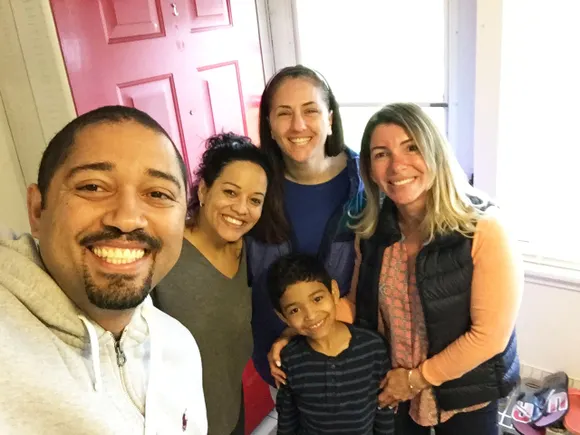
When Katrina Branch received a notice from her niece's elementary school saying that teachers would be making home visits, she immediately felt worried. Branch, who had recently lost her mother and sister in a short period, had just moved from Pennsylvania to Washington, D.C., to raise her sister's five children.
"Teachers usually don't come to your house unless something bad is going on at home," Branch said. "I thought they were coming to find problems and take the kids away from me."
She eventually agreed to a home visit, and that visit, she said, changed her life. The visiting teacher asked about the family's hopes and dreams and asked her niece about her favorite toys and activities. Branch said the visit made her feel welcomed and accepted by the school.
The experience was so positive that Branch began volunteering at the school, became president of the Parent Teacher Organization (PTO), and served on school committees. The school even hung her photo on the wall. She now works as a classroom assistant at a charter school in Washington, D.C., and runs before- and after-school programs.
"There is so much division right now, and the home visit practice, I think, breaks down those barriers."

Gina Martinez-Keddy
Executive Director of Parent Teacher Home Visits
Twelve years after her first home visit, Branch became aParent Teacher Home Visitsnational trainer for the nonprofit organization, which promotes positive school-family relationships through home visits.
"Once I let my guard down, it opened so many doors for me. I could easily go and talk to teachers at the school because they knew I was a parent who cared about my kids, and they knew I valued my nieces' education," Branch said.
Core Practices
Parent Teacher Home Visits (PTHV) is an optional program for both educators and families. Although many teachers, especially in lower grades, make home visits before the school year begins to welcome students and parents, this is a specific program with five core practices:
- Home visits are always voluntary and scheduled in advance.
- Teachers receive training and are compensated for home visits conducted outside of school hours.
- The first home visit focuses on building a positive relationship by discussing the hopes and dreams of the student, family, and teacher.
- Teachers visit a cross-section of student families to avoid stigmatization or perceived favoritism.
- Teachers conduct home visits in pairs and reflect after each visit.
Ideally, teachers visit student families twice per school year—once at the beginning of the year and once in the winter or spring. Each visit includes the student and lasts about 30-45 minutes.
While the first home visit does not involve discussions about the student's academic needs or progress, the second visit may involve preparing the student for the next grade level or other educational information.
Gina Martinez-Keddy, executive director of the PTHV program, said the program aims to make home visits a foundational practice in schools. "I often say that when trust is built within the school and between families and the school, everything else can go much more smoothly," she said.
Since the organization was founded in 2003, educators have conducted 26,507 in-person and virtual home visits with pre-K through 12th grade students nationwide. School districts or schools must opt into the program because these entities typically pay teacher stipends, which are contracted at an hourly rate based on locally agreed-upon wages and include driving time and expenses, Martinez-Keddy said. Not all schools in a district or all teachers in a school must participate.
Information teachers gather during home visits can be used to incorporate students' interests and preferences into the curriculum. The primary goal is to start the school year with positive family-school connections, Martinez-Keddy said.
These positive connections can lead to increased parent involvement, higher student attendance, reduced implicit biases that educators and families may hold, and even a willingness to discuss more difficult topics if academic or behavioral issues arise during the school year, she said.

Research released in 2018 by the Johns Hopkins University School of Education found that, on average, schools that systematically implemented PTHV sawdecreases in chronic absenteeismand improvements in English language arts and math proficiency. In one studied school district, schools with regular home visits saw a 5% increase in students scoring proficient on ELA tests, compared to a 3% increase in schools without home visits or with home visit coverage of less than 10% of families.
Additionally, the study found that students attending schools with home visit coverage of at least 10% of student families were less likely to be chronically absent.
"There is so much division right now, and the home visit practice, I think, breaks down those barriers," Martinez-Keddy said. "It gets people to sit down and see each other as human beings."
Grassroots Origins
Yesenia Ramirez co-founded PTHV while she was a single mother of six girls and had just left an abusive relationship. Her activism began with frustration.
One day in 1995, she showed up at her daughter's school in the Sacramento City Unified School District in California to discuss her concerns about her child's reading progress. The teacher was unavailable to speak with her, so she left her phone number.
When no one called her back after a few weeks, she returned to the school and waited 45 minutes. Still, no one was willing to speak with her.
As she left the building, she muttered a curse word in Spanish. At the same time, a woman entering the building heard her and asked what was wrong. That woman happened to be the school's vice principal, who took Ramirez to her office and discussed the lack of connection between the school and the community, including parents.
Ramirez, along with the vice principal and other parents and educators, began exploring ways to improve relationships. Organizers heard that teachers and families were responding positively to home visits, so they launched a pilot program and conducted 150 home visits within two years, Ramirez said.
They brought the research to the local teachers union, which supported the effort, and then to the district superintendent, who agreed to the program after conducting several home visits. The home visit program launched in 1998 in six elementary schools and two middle schools in the Sacramento district, funded with $100,000 from the district, Ramirez said.
"When you go to the home, we are not teachers. We are big listeners who ask the right questions."
Tyler Post
Physical Education and Health Teacher, Washoe County School District
The following year, six more schools joined. Soon, other school systems in California and other states adopted the model. Ramirez is pleased that the grassroots home visit program has spread nationwide.
According to Ramirez, home visits help the community understand how much educators do for students and families. "If we can support them in any way, I think that's when success happens," Ramirez said.
"We Are Just Like Our Kids"
Tyler Post, a physical education and health teacher in the Washoe County School District in Reno, Nevada, got involved with the home visit program five years ago when he was teaching at an alternative school in the district. He received a district email about the program, and since he had been conducting informal home visits throughout his decades-long education career, he signed up for training. Now, he also uses PTHV core practices to train other teachers in home visits.
When Post first contacts parents to request a home visit, he tries to reassure them immediately by telling them what a great day their child had at school. If parents don't want to participate, he doesn't push, but he reaches out again after a few weeks or months to see if they've changed their minds.

Educators involved in PTHV say the two biggest barriers to home visits are finding time to meet with parents and addressing any hesitation about home visits.
Post says that if parents aren't comfortable meeting at home, he suggests other meeting places, such as a park or restaurant. He has even met with a family while they were shopping.
During home visits, Post says he enjoys learning about students' passions and parents' goals for their children. He also likes sharing with families and students his joy in being a teacher.
"We're not going to give them our opinions," Post said. When he trains other teachers, he tells them, "When you go to the home, we are not teachers. We are big listeners who ask the right questions."
Post says he and other teachers get as much out of home visits as the families and students do. "It challenges us (teachers). Some days we all shed tears and say, 'This is the greatest thing we've ever been blessed to share,' and it makes us step back as educators and say we are just like our kids. We are the same. We have hopes and dreams."
Nancy Lopez was introduced to PTHV 18 years ago as a student teacher when her mentor took her on a home visit. After teaching kindergarten for several years at a bilingual school in Sacramento, she decided to conduct home visits with her students' families and says the practice is "the biggest game-changer in my teaching career because it truly connected me with my students and families."

She always conducts her first home visit before the school year begins so she can get to know the family and student, and they can get to know her. "On the first day of school, nobody cries. No parent cries when they leave their child with me on the first day," Lopez said with a laugh.
Lopez is now a family and community engagement resource teacher in the Elk Grove Unified School District near Sacramento, California, where she manages the district's home visit program.
In her district, more than 120 languages are spoken, Lopez said. When families and educators don't speak the same language, the school provides a translator or asks if the family would prefer a friend or relative other than the student to translate. Some home visits even happen without a translator, with educators and families sharing photos, artwork, and time together, she said.
"I think it's taking that extra step to go into the home and truly listen to their stories and experiences," Lopez said. "I mean, what you learn is amazing."