
Campus COVID Testing: Scaling Up or Phasing Out?
Only months after the Biden administration announced expanded COVID testing in K-12 schools, some school districts, due to shortages of testing resources and parental opposition, plan to limit or cancel on-campus testing, while others are intensifying testing. The divergence in testing strategies has sparked discussions in the education community about the prospects of testing programs.
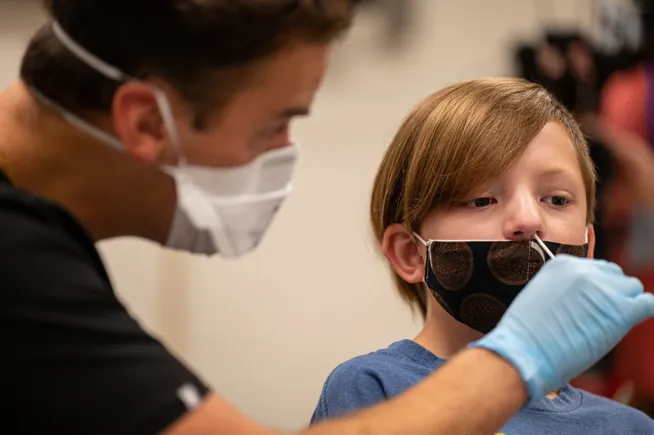
Months after the Biden administration announced the expansion of COVID-19 testing in K-12 schools, some school districts say they plan to limit or even phase out on-campus testing. At the same time, other districts are strengthening their testing efforts. This divergence has raised questions within the education community about the future of school-led testing programs: Should educators redirect resources and energy toward other mitigation measures, or continue to expand this safety practice that has been widely promoted since the first year of the pandemic?
Some observers note that momentum for school testing programs waned in December and January—when schools, like municipalities and households, faced a surge in COVID-19 cases, but rapid antigen test kits were in short supply and PCR test results were delayed. Increased resistance to mitigation measures from parents and even some medical professionals has also left some district administrators feeling overwhelmed when promoting voluntary testing programs, even as they acknowledge that testing is an effective way to keep students in school.
School leaders say that amid staffing shortages, academic acceleration pressures, and other K-12 challenges, the complexity of maintaining a predictable and equitable testing program to address a potentially deadly virus can be overwhelming.
"I think at a macro level, school districts are becoming extensions of public health agencies, having to educate parents about the importance of COVID testing and vaccination, with administrators taking on unprecedented public health roles," said Ana Vasudeo, board president of the Berkeley Unified School District in California and general manager of the Safely Opening Schools project. Safely Opening Schools is an initiative of the Public Health Institute, in partnership with the California Department of Public Health, providing technical support to schools for on-campus testing programs.
Divergence in practice
Running routine screening testing programs (typically testing everyone weekly) or "test-to-stay" programs (testing known exposures through contact tracing) is far more complex than simply obtaining test kits and laboratory support. The choice of test type, who to test and when, and restrictions on those who test positive are often the most contentious areas.
"Should different testing policies apply to household close contacts of positive cases versus on-campus close contacts? What is the best testing approach for students with significant cognitive disabilities? How should all data be tracked and kept secure?" These and many other questions are troubling school administrators.
National and state guidance has also changed frequently as the virus evolves, forcing districts to continually adjust strategies and explain shifting practices to staff and families. For example, in late December, the U.S. Centers for Disease Control and Prevention updated guidance on shortened isolation and quarantine periods, suggesting that test-to-stay could serve as an alternative to home quarantine for close contacts.
Over the past month, several states, including Connecticut, Vermont, Massachusetts, and Ohio, have said they are de-emphasizing test-to-stay programs and contact tracing. Ohio has also shifted from daily to weekly reporting of COVID-19 cases in K-12 schools.
In some regions, school system leaders have had to factor opposition to testing into their strategies. For example, Florida Governor Ron DeSantis has criticized schools that require negative test results for students and staff to remain on campus, telling reporters in early January: "Using testing as a tool to restrict opportunities and limit people's ability to receive an education is not a good approach," according to Politico.
The obstacles
As part of the $10 billion in funding for school COVID testing in the American Rescue Plan, states must submit school testing plans detailing how screening testing will be conducted, who will be tested, partners involved, and how funds will be used. Several administrators, education advocates, and testing suppliers say that access to funding is not the primary obstacle; the real barriers are obtaining sufficient test kits and, in some areas, delays from suppliers coordinating testing efforts.
Last month, the Biden administration announced it would provide 5 million rapid antigen tests and 5 million lab-based PCR tests to schools each month. Although this news was welcome, Mike Magee, CEO of Chiefs for Change, said it still falls short of demand. That volume equates to one test per month for one in five students in the United States.
"Our members are scouring the country for test kits, which is both unnecessary and unfortunate," Magee said. An informal survey of Chiefs for Change members in early January showed that 80% of respondents said they had either run out of COVID test kits or would run out within a month.
School administrators also face the burden of the paperwork, electronic documents, and data management systems needed to prepare and manage on-campus testing, as well as tracking tested students.
"Part of what makes this so difficult for school districts right now is that this level of strategic planning is something many districts have never been asked to undertake."

Mike Magee
CEO of Chiefs for Change
Brent Stephens, superintendent of the Berkeley Unified School District in California, said the district tests students twice a week with rapid antigen tests. Managing 20,000 tests per week requires contract staff and a "large volunteer force" to register, proctor, and assist with data entry. Stephens said the district allocated $2 million to build the testing program. Although testing helps increase confidence in identifying positive cases, Stephens believes the system is not financially or logistically sustainable in the long term. However, looking ahead to the post-COVID era, the district plans to maintain the basic framework of the testing program to enable rapid expansion in response to future public health threats.
"If I were to encourage legislators to look ahead to the summer and next year, it would be that districts must maintain a certain level of contact tracing and testing infrastructure so they can flexibly respond to any situation that arises," Stephens said.
Support for districts
Education advocacy organizations such as Chiefs for Change have published resource guides for testing programs. The U.S. Department of Education, in collaboration with the CDC, the Rockefeller Foundation, and district leaders, has hosted a series of webinars on strengthening on-campus testing programs. Additionally, the Open & Safe Schools project, a collaboration of federal agencies, has created a detailed toolkit to help states and schools plan, budget, and implement on-campus testing programs.
Laura Bronner, who leads the national K-12 testing program at Concentric by Ginkgo Bioworks, a synthetic biology company, coordinates multiple testing models across thousands of schools in 10 states. Much of the work focuses on pooled PCR testing—combining nasal swabs from a group of asymptomatic students into a single large tube and testing it as one sample. If the result is positive, further individual testing is conducted. Before the emergence of the Omicron variant, typically one in 100 pooled samples was positive; now the positivity rate has risen significantly, Bronner said.
"We are learning every day what works and what doesn't, but we are still keeping kids in school."
Laura Bronner
Head of the National K-12 Testing Program at Concentric by Ginkgo Bioworks
Bronner said the most successful on-campus testing programs typically conduct tests at a fixed time each week. The company customizes operations based on the needs of each school and state and adjusts as local needs change. "We are learning every day what works and what doesn't, but we are still keeping kids in school," she said.
Health advisors and education advocates point out that launching an on-campus medical testing program for a virus that did not exist 26 months ago is inherently challenging, but it should not overshadow other work of school leaders. "Part of what makes this so difficult for school districts right now is that this level of strategic planning is something many districts have never been asked to undertake," Magee said.
Looking ahead
Despite the operational complexity of on-campus testing, there remains broad support for schools playing a leading role in testing, because it incentivizes in-person instruction and schools often serve as community hubs that can facilitate accessible and equitable testing. Several health experts and educators predict that schools will eventually phase out routine testing and test-to-stay programs, testing only symptomatic students and staff. But this will depend on local positivity rates, the overall trajectory of the virus, and local, state, and federal guidance.
Lynn Silver, director of Safely Opening Schools, said the future may place more emphasis on home testing rather than school-managed programs, but careful planning is needed to avoid shifting all responsibility onto families. "Until there is a clear and feasible way to support families in free home testing, schools will still need to provide this service, and may still need to provide testing for symptomatic individuals at school for some time," Silver said. She noted that current and future challenges include how to sustain and fund on-campus testing, and how and when to transition to home testing. "The third question is, how long do we actually need it? That's the $64,000 question," Silver said.
Magee believes federal support is needed to establish a permanent, sustainable approach to COVID testing, because the current system that relies on school leaders planning multiple testing scenarios is not viable in the long term. "This is not a comprehensive testing solution, and looking ahead, this is almost certainly a persistent, unpleasant endemic virus for years to come," Magee said. He suggested establishing a systematic stockpile strategy so that test kits can be easily accessed on demand, similar to how cold regions stockpile de-icing salt for winter. "A lot of what we've been thinking about recently is that, based on the experience of the past few years of the pandemic, we will have to build sustainable virus surveillance methods based on local and regional infection rates, and the federal government must help," Magee said.