
Five Major Trends in Education Policy for 2025
In 2025, U.S. education policy is set to undergo dramatic changes. Trump's second term has already begun overturning multiple policies from the Biden era, while several key Supreme Court rulings could reshape the educational landscape. Based on interviews with experts from AASA and the Thomas B. Fordham Institute, this article analyzes five major policy trends: persistent policy swings, judicial impacts after the overturning of the Chevron doctrine, constitutional challenges to the E-rate funding mechanism, curriculum opt-out lawsuits, and the future direction of the Department of Education.
Five Major Trends in Education Policy to Watch in 2025
Interpreting policy directions is no easy task, especially when facing the ever-changing complex landscape of education policy. President Donald Trump's second term has already begun bringing a series of changes to the education sector, the latest being the revocation of a Biden-era policy onbook bans. Even so, like the weather, some changes are easier to predict than others.
From the areas where school leaders may face the biggest policy reversals under the new administration, to the potential impact of pending Supreme Court decisions on school districts, here are five major policy trends worth watching this year.
Policy whiplash continues
With Trump back in the White House, school leaders can expect more policy "ping-pong," said Noelle Ellerson Ng, associate executive director of advocacy and governance at AASA, The School Superintendents Association.
She noted that Title VI of the Civil Rights Act, which prohibits discrimination based on race, color, and national origin, and its related regulations, could likely be actively used to investigate schools' diversity, equity, and inclusion (DEI) initiatives or so-called "critical race theory" in curricula. Additionally, she believes that the newly required "Head Start" wage increases and EPA requirements for lead testing in schools could also become casualties of policy shifts.
Similarly, lackluster recovery in chronic absenteeism and academic assessment performance could cause the pendulum on student behavior and discipline policies to swing again, said Michael Petrilli, president of the Thomas B. Fordham Institute, a conservative-leaning education reform think tank. Beyond stricter policies on cellphone use during school hours, growing concerns over classroom disruptions, low student engagement, fights, and other behavioral and engagement issues are likely to trigger further policy adjustments.
Petrilli believes that, in essence, schools may again need more "tough love," "making clear to students that they need to meet behavioral expectations and that we expect them to rise to those expectations."
One major area to watch is Title IX regulations. During the Biden administration, this anti-sex-discrimination law was interpreted to include LGBTQ+ students and employees within its protections.
In early January, before the administration change, afederal judge overturnedthe Biden administration's final rule establishing those protections, after months of legal back-and-forth. Just weeks earlier, the U.S. Department of Education had withdrawn another rule attempting to extend Title IX protections totransgender student athletes.
So far, the Trump administration hasissued executive ordersdeclaring that the United States recognizes only two sexes: male and female. The president also vowed during his campaign to exclude transgender athletes from women's sports.
However,a 2024 Supreme Court rulingmay resolve the "ping-pong" on this and other issues in the judicial arena.
Chevron doctrine forces courts to act as policymakers
Ellerson Ng said that underpinning all this is the Supreme Court's ruling last year inLoper Bright Enterprises v. Raimondowhich overturned theChevron doctrine. This 40-year precedent allowed federal agencies to exercise professional judgment in interpreting and administering laws within their areas of jurisdiction, but theLoper Brightruling shifted much of that regulatory power to the judiciary.
"When someone is unhappy with how a regulation or guidance is being used or thinks it doesn't apply, in the post-Chevron era, they can say, 'Since agencies shouldn't be managing this, how viable is this regulation?'" Ellerson Ng said. "I think this will only increase the number of implementation issues playing out in lower courts."
Petrilli added: "It would be a bit ironic if the overturning of Chevron is used in this way, because it was celebrated by conservatives. It could end up limiting the Trump administration."
The numerous conflicting lower court rulings on whether Title IX protects LGBTQ+ students and employees will likely eventually force the Supreme Court to weigh in—although the Court has declined in recent years to hear multiple cases involving transgender student rights.
"Whether Title IX provides protections for transgender or even gay students is a big question," Petrilli said. "I don't think the Supreme Court has ruled on that yet." However, the Court ruled inBostock v. Clayton Countythat Title VII of the Civil Rights Act of 1964 protects employees from discrimination based on sexual orientation or gender identity in the context ofworkplace discrimination.
Whether and when the Supreme Court will take up such cases remains uncertain, but the justices have two high-profile K-12 cases pending in the coming months.
The future of E-rate in question
A high-profile case in the Supreme Court's current term could significantly affect school district budgets and operations nationwide—especially depending on when it is decided.
In a case combining two earlier ones—Schools, Health and Libraries Broadband Coalition v. Consumers' ResearchandFCC v. Consumers' Research—the justices will decide whether the funding mechanism of the Federal Communications Commission's Universal Service Fund, which administers the federal E-rate program, is constitutional.
Through the E-rate program, schools and libraries across the country can receive subsidies for broadband internet services.
"We hope the Supreme Court doesn't rule on such matters before the end of the term, like in June, which is right at the end of the school year," Ellerson Ng said. If a ruling comes in March or April—during the critical period of testing, grading, and student advancement—and immediately abolishes the funding mechanism, it would be "disastrously chaotic."
Meanwhile, she said, school districts should tell their E-rate stories: how large their internet budgets are, the scale of discounts, and how important these internet connections are to student learning, school safety, and building operations.
Curriculum opt-out ruling could trigger slippery slope effects
Another case that could lead to policies creating more questions than answers involves parents' ability to opt their students out of certain curricula.
The Supreme Court just announced in January that it will hearMahmoud v. Taylor. The case will decide whether school districts violate parents' First Amendment religious rights when they do not provide notice or a way for parents to opt their children out of lessons related to gender and sexuality.
Thelawsuit was filed bya group of Christian and Muslim parents against the Montgomery County Board of Education in Maryland, over an LGBTQ+-inclusive language arts curriculum for pre-kindergarten through fifth grade. The school board initially offered parents a way to opt their children out of the curriculum, but laterrescinded that policybecause "individual schools could not accommodate the growing number of opt-out requests without seriously disrupting the classroom environment."
Petrilli said the court's ruling could ultimately open a Pandora's box. "There are so many ways that school curricula could be interpreted as conflicting with someone's religious values, you know?"
He said that beyond gender and sexuality lessons, other subjects that could be challenged under such a ruling might include evolution or climate change.
Petrilli also noted the element of school choice involved in this matter.
"Montgomery County is a place without many options beyond traditional public schools. Does that matter? If it were in a state with a strong charter school sector or a private school voucher program, would it have more leeway to do this kind of thing?" he asked. "That will be an interesting question to watch."
The Education Department won't disappear anytime soon
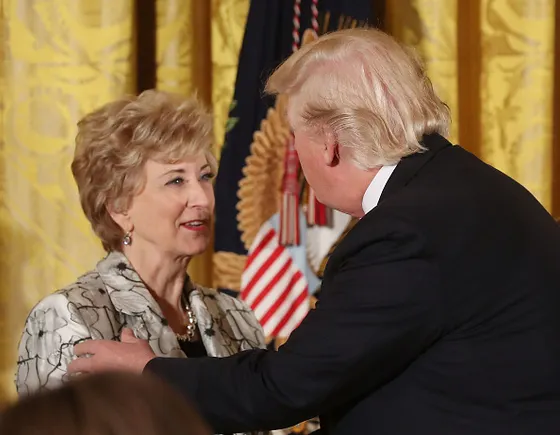
Trump has nominated Linda McMahon, former president and CEO of World Wrestling Entertainment, to lead the Education Department—for now. However, eliminating the agency remains a frequently repeated campaign goal. The new president expressed similar sentiments in his nomination announcement for McMahon (which still requires Senate confirmation): "We will send education back to the states, and Linda will lead the charge to do that."
However, Ellerson Ng said lawmakers are unlikely to actually follow through on eliminating the Education Department, "because they absolutely do not want to completely eliminate Title I and IDEA (the Individuals with Disabilities Education Act)."
But that doesn't mean there won't be "symbolic abolitions," such as moving Title I, IDEA, the Office for Civil Rights, or other programs or offices to other agencies, Ellerson Ng said—but that would still come at a cost. "A major reorganization of the federal government is not without costs."
Petrilli expressed a similar view: "I think the likelihood of the Education Department being eliminated or even partially dismantled is extremely low, because that would require an act of Congress, meaning 60 votes in the Senate, and that's not going to happen."
However, cutting the department's workforce is another matter.
"It's clear the administration wants to encourage many career civil servants to retire by requiring a return to in-office work and eliminating DEI positions," Petrilli said in an email. "But the Education Department will continue to exist!"