
After a Campus Shooting, How Teachers Face the Dual Pressures of Trauma and Teaching
After the Uvalde school shooting, teachers across the country continue teaching amid fear and stress. Experts note that trauma responses recur, compounded by systemic racism, and both teachers and students face mental health challenges. Teachers call for more support, but scarce resources and policy constraints worsen the predicament, potentially exacerbating teacher attrition.
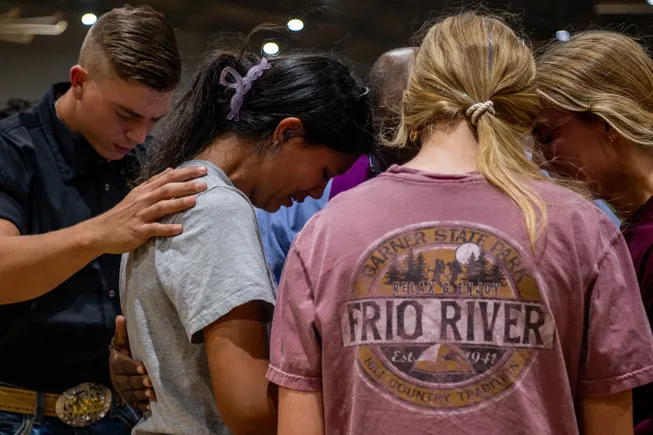
On Wednesday morning, teachers and students across the country walked into school hallways and classrooms less than 24 hours after news of the Uvalde school shooting broke. Students still had to take final exams, and teachers had to grade papers and continue teaching. On the surface, everything seemed normal.
But a familiar feeling of unease told Chanea Bond otherwise.
"I saw colleagues crying today," Bond said on Wednesday. An English and literature teacher in Fort Worth, Texas, she was about 350 miles from the scene, where less than a day earlier, 19 children and 2 adults had been fatally shot in a classroom. Bond said she and her colleagues were experiencing a range of emotions, from fear and helplessness to stress and tension.
"We're just balls of stress and tension waiting for the next thing to happen," she said. "Our bodies are exhausted. We can't sleep. A lot of people are physically struggling."
Yet Bond and thousands of teachers like her across the country had to keep going.
"Because if I don't, everything will fall apart."
Teachers repeatedly traumatized
The emotional, physical, and behavioral side effects reported by educators nationwide after the Uvalde massacre are not new. Many teachers have experienced this ripple effect after similar school shootings at Sandy Hook, Virginia Tech, Parkland, Santa Fe, Oxford, and others.
Addison Duane, a professor at Wayne State University, former elementary school teacher, and PhD in educational psychology, noted that these reactions are symptoms of trauma responses. Duane's research and expertise include trauma and racism in schools.
After a school shooting, the impact of direct, indirect, and vicarious trauma ranges widely, from emotional feelings of losing control, increased anger or aggression, to behavioral withdrawal. Physical symptoms may include headaches, stomachaches, insomnia, or loss of appetite.
"No one says, 'Hey, I know this is really hard. I know this is impossible.' It feels like we're being asked to carry all the burdens that come with being around young people."
— Chanea Bond, English and literature teacher in Fort Worth, Texas
Bond described her ears ringing as she walked from the parking lot to the school door on Wednesday morning.
"Our bodies go through that trauma over and over again," she said.
Trauma after school shootings can compound existing trauma caused by systemic racism, especially for those working in or belonging to historically marginalized communities such as Black, Hispanic, and low-income students.
Robb Elementary School is one example: according to district data, 90% of the school's students are Hispanic and 87% are economically disadvantaged.
Duane said compounded trauma has now become "a ubiquitous part of the American experience."
In this context, teachers are still expected to continue teaching.
"No one says, 'Hey, I know this is really hard. I know this is impossible,'" Bond said. "It feels like we're being asked to carry all the burdens that come with being around young people."
Teachers are also responsible for the social and emotional well-being of the children they serve, while reporting higher levels of stress, burnout, and fatigue themselves.
"This has a ripple effect on those around us," Duane said. "Think of a classroom that is often overcrowded and under-resourced—you name it. This trickle-down effect is very real and can be quite devastating for the children in it."
Students experience 'slow-rolling trauma'
On April 20, 1999, seniors Eric Harris and Dylan Klebold opened fire at Columbine High School in Littleton, Colorado, killing 15 people and injuring 24, an event recorded as one of the deadliest school shootings in U.S. history. Many educators at the time were still in elementary or middle school and recall finding it hard to imagine.
More than two decades later, the event is now considered the fourth deadliest, surpassed by Sandy Hook in 2012, Parkland in 2018, and Uvalde this week.
In the nearly ten years since the last elementary school mass shooting in Newtown, Connecticut, more than 900 shootings have been reported on school grounds, according to the White House.
When teachers see themselves in national headlines with death tolls, so do their students.
Teachers worry that the result is a generation of students increasingly desensitized to violence.
"The violence is right in front of them," Bond said.

Many of these students have also recently lost family members, friends, and neighbors due to the COVID-19 pandemic.
"Even if we try to keep kids in some kind of isolation... this has been a slow-rolling trauma for years," said Gerard Lawson, a licensed professional counselor who helped coordinate the response to the 2007 Virginia Tech shooting. Lawson specializes in crisis management, is a professor at Virginia Tech's College of Education, and is a past president of the American Counseling Association.
School safety, disaster response, and trauma experts advise teachers and education leaders to build or strengthen relationships with students, promote peer connections, and work to reassure students that they are safe—things made more difficult by the pandemic's damage to school connections and students' social and emotional well-being.
Many have repeatedly called on school principals, superintendents, counselors, and psychologists to exercise leadership skills and foster a positive school climate.
"But the reality is, this is just another example that no community is immune to this," Lawson said.
However, students in low-income communities and some Black and Hispanic communities are more likely to face barriers to accessing mental health care due to stigma, lack of or inadequate health insurance, and shortages of resources such as psychologists.
In a field where "trauma-informed practices" have become buzzwords in these historically marginalized communities, teachers describe significant trauma and inadequacies. Large class sizes, high psychologist-to-student ratios, and lack of professional development are just some of the concerns.
"Someone coming in to hurt me and my students doesn't scare me as much as someone who is already here and can't handle their own trauma and acts out," Bond said. "The type of citizens we send out into the world, those people are more likely to be dangerous because they don't know any better."
'I don't know how to be there for them'
Teachers across the country have taken to social media to say that many school leaders' lack of resources and empathy has exacerbated their stress after Uvalde.
Yet this situation is not uncommon—the sentiment dates back at least a decade to Sandy Hook.
"I will never forget my eighth graders pulling out their phones at the end of the day and seeing the Sandy Hook news in real time," said one person who was a middle school teacher in Massachusetts at the time. "I didn't know how to be there for them," said the former teacher, who requested anonymity because she now works in curriculum publishing and is not authorized to speak publicly. She said she frequently enters school buildings in this role.
Now, with states like Florida banning social-emotional learning as part of "critical race theory," teachers may find it harder to have unguarded conversations with students.
"They (students) need to go to school for their mental health, but they're not safe at school because they could be hit by a bullet. They can't wear masks, but people in the community are sick," Bond said, referring to states that have banned school mask mandates. "It feels like we're always at the center of those moral and political debates without the resources to help us cope."
But in 2012, the former Massachusetts teacher recalled reviewing safety protocols with her students in case a gunman entered the building. She said she had her own secret resource: a hammer in her desk to break a window for students to escape during a lockdown. She remembered many colleagues also kept hammers in their desks for this purpose.
"There were two plans at the time: the official 'duck and cover' plan, and the 'if that happens here, the hammer is here' plan," she said.
When she finally left teaching in 2016 after a seven-year career, she described her parents' initial reaction as one of relief.
After the Uvalde shooting, other teachers—those who had already reported high levels of burnout and stress after the pandemic—may also quit.
"Teacher retention is a problem right now, and this (shooting) could exacerbate it," said Julia Martin, a former education policy advisor to the Senate Education and Labor Committee. Martin currently serves as legislative director at the law firm Brustein & Manasevit.
According to a survey released by the American Psychological Association in March, about one-third of teachers reported receiving at least one verbal harassment or violent threat from a student during the pandemic, and nearly 50% said they planned or wanted to quit or transfer.
"Of course, the shadow of school shootings—in this case, two teachers were killed—is a deterrent for many who would otherwise become teachers, and it could also be the last straw for those already considering leaving the profession," Martin said.
Bond, who has taught for seven years, said she plans to eventually leave teaching entirely.
"I would love to just teach, but that's a luxury we don't have right now," she said. "I don't know if I'll still be alive if I try this for another 10 years."
Correction: In a previous version of this article, Chanea Bond's name was misspelled.