
Threat Assessment: Preventing School Violence or Creating Student Trauma?
School threat assessment, as a formalized means of preventing violence among K-12 students, is facing growing opposition. Civil rights and disability advocacy organizations point out that students with disabilities, students of color, and students from low-income families are disproportionately subjected to investigations, and that assessments may bypass protections under the Individuals with Disabilities Education Act, resulting in informal suspensions and lasting trauma. Supporters such as Dewey Cornell, a professor of education at the University of Virginia, argue that systematic assessment can prevent schools from making hasty decisions based on intuition or panic, and cite research showing that most threats are determined to be low-risk or transient. The U.S. Department of Education recently solicited comments on non-discriminatory practices in school discipline, receiving over 3,600 comments. This article reviews both sides' arguments, key data, state-level policies, and school district cases, and explores directions for improvement.
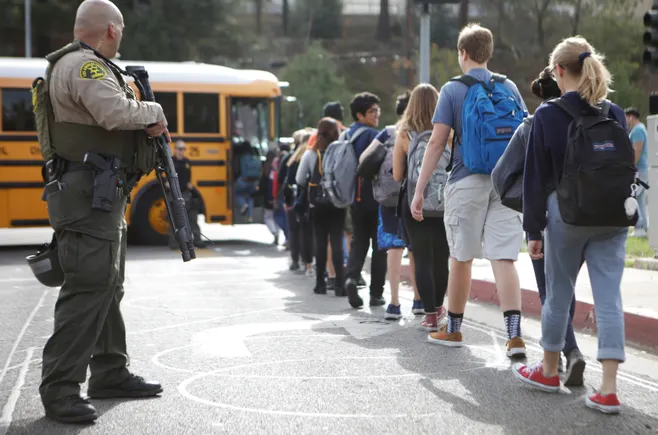
School threat assessment—a formalized approach aimed at preventing potential violence among K-12 students—is facing a growing number of opponents. They point out that students with disabilities, students of color, and students from low-income families are disproportionately placed under investigation. Multiple civil rights organizations argue that threat assessment contributes more to the "school-to-prison pipeline" than it actually prevents tragedies.
However, supporters say threat assessment provides school staff with a structured system for conducting sensitive and serious information gathering to evaluate the likelihood of a student harming others. Without such a system, school employees are more likely to overreact and make hasty decisions, thereby improperly—and possibly disproportionately—pushing more students toward suspension, expulsion, or arrest.
"The question is whether they do these things based on intuition, impulse, fear, and anxiety, or whether they do them systematically according to standard procedures," said Dewey Cornell, a clinical psychologist and professor of education at the University of Virginia, who has long been involved in school threat assessmenttraining and research. "Schools cannot avoid threat assessment," Cornell said. "The question is how they will conduct it."
"Referrals to Nowhere"
Opposition to school threat assessment has persisted for years, especially among civil rights and disability rights groups. They have tried to raise the alarm about the practice, comparing it to "giving every person with a headache a CT scan to prevent brain tumors"—the scan might find a few brain tumor patients, but the excess radiation would pose a higher cancer risk to many more people.
"The population subjected to threat assessment is much larger than any potential shooter. This is causing enormous harm to many children," said Miriam Rollin, director of the National Center for Youth Law, one of the organizations opposing the practice.
Recently, the U.S. Department of Education requested public comments onnondiscriminatory practices in school discipline, intensifying the debate. More than 3,600 comments were received, which may be used to assist the Department's Office for Civil Rights in developing further guidance, technical assistance, and other resources. As part of the request for comments, the Department specifically asked for views on threat assessment practices.
Some organizations and individuals submitting responses asked the Department to provide guidance on the civil rights implications of threat assessment or to develop policies preventing law enforcement involvement. The organization Dignity in Schools suggested rewording the term to focus on the support students might receive as a result of threat assessment, rather than labeling students as "threats."
"The population subjected to threat assessment is much larger than any potential shooter. This is causing enormous harm to many children."
—Miriam Rollin, Director of the National Center for Youth Law
Fifty local, regional, state, and national organizations, including the National Center for Youth Law, jointly submitted a seven-page letter expressing multiple concerns about threat assessment. The letter stated that the practice aims to connect assessed students with school or community resources, but due to insufficient funding and availability of school and community resources and support, such connections rarely materialize.
"Referring someone to a place that doesn't exist does nothing to help the child's situation," Rollin said. "Giving a child a referral for services when there are no services available is an injustice—because we're spending all our resources on school police and threat assessment." She added that the lasting trauma students may suffer after becoming the subject of a threat assessment is also a concern.
Informal Exits for Students with Disabilities
Another concern is that threat assessment may bypass the legal protections provided to students with disabilities under the Individuals with Disabilities Education Act (IDEA).
Diane Smith Howard, managing attorney for criminal and juvenile justice at the National Disability Rights Network, said informal school exits are the number one issue reported by state protection and advocacy systems related to school discipline challenges, and threat and risk assessment is a form of informal exit.
Smith Howard noted that threat assessment teams often do not include members of a student's Individualized Education Program (IEP) team when evaluating potential threats. "So the people who truly know the child and their disability-related needs are not part of the process," she said.
When threat assessment teams operate outside special education procedures, the role of the child's disability is not examined, and the protections of IDEA and Section 504 of the Rehabilitation Act are not activated, potentially leading to discrimination based on disability, Smith Howard said. In cases where risk assessment leads to removal from school, this results in unofficial exits—until the child is deemed no longer "dangerous" through a psychological evaluation, the cost of which may be borne by the family or performed by unqualified providers. Many families cannot afford this, so the child remains out of school, she said.
A "Calmer, More Common-Sense" Approach
Cornell pushed back against these criticisms, saying they are based on a small number of publicized cases where students were mistreated at school. He said that when used faithfully, the five-step decision-tree process of the threat assessment model provides a data-driven approach to problem-solving and conflict resolution, helping school teams determine the true intent of a student's threat and decide what interventions should be taken.
It is a tiered system where, in most cases, perceived threats can be quickly resolved because a multidisciplinary team will determine that the student may have said or done something inappropriate but is not violent, Cornell said.
"Schools cannot avoid threat assessment. The question is how they will conduct it."
—Dewey Cornell, Professor of Education at the University of Virginia
Cornell's research shows that two-thirds of the threats studied were classified by school teams as low-risk or "transient," meaning the threatdid not pose a serious risk of violence。
"We just think this is a calmer, more common-sense way to handle student threats," Cornell said. He cited research data from schools using theComprehensive School Threat Assessment Guidelines(CSTAG) regarding suspensions, expulsions, and law enforcement actions. He also said it helps connect students with services that can address their problem behaviors.
A 2020 report co-authored by Cornell, based on threat assessment research over four school years in Virginia, showed that 32% of students werereferred for school-based counseling, 19% received mental health assessments, 19% received school-based or community-based mental health services, and others received additional assessments and services.
The research in the report also showed:
- Of the 12,000 threat assessments in the 2017-18 school year, none resulted in serious harm.
- In 97% of cases, there was no known attempt to carry out the threat.
- Schools took disciplinary action against students in 71% of threat assessment cases.
- In 47% of cases, schools consulted with a school resource officer or other school safety expert.
Regarding racial disparities, research published by Cornell in 2018 examined 1,836 threat assessment cases across 779 schools and found no statistically significant differences among Black, Hispanic, and White students in suspensions, expulsions, transfers, or legal consequences. However, Black students were referred for threat assessment at 1.3 times the rate of White students.
Students receiving special education services were about three times more likely to make threats than general education students. The research also showed that fourth graders (11%) and fifth graders (11%) made the most threats.
State Policies and District Experiences
School threat assessment approaches have beenrecommended by the U.S. Secret Service、, the Department of Homeland Security, and theDepartment of Educationas best practices.
Over the past decade, the use of threat assessment in K-12 schools has grown, especially after the 2018 shooting at Marjory Stoneman Douglas High School in Parkland, Florida.Marjory Stoneman Douglas High SchoolDuring the 2018 legislative session, Florida and Maryland adopted threat assessment models as a strategy forpreventing school violence. According to research by the Education Commission of the States, Kentucky, Tennessee, Texas, and Washington state passed similar policies the following year.
Loudoun County Public Schools in Virginia, with 81,000 students, has conducted thousands of threat assessments over the past 16 years. John Lody, director of diagnostic and preventive services for the district, said that in all those cases, no threat violence was ever carried out. He said this not only may have prevented school violence but also provided support for students who might have been on a path to violence.
"Our approach is not to suspend students unless absolutely necessary as a safety measure," Lody said. "Our approach is to address the root problem that initially caused the threat." The district's annual suspension rate is below 1%, Lody said. He added that the approach is more equitable across different student groups because every school has a threat assessment team that objectively examines information from various sources and makes decisions based on each student's circumstances.
"We no longer ask 'What's wrong with that kid?' but instead start asking 'What happened?' This changes the entire paradigm."
—Travis Hamblin, Director of Student Services, Jordan School District, Utah
Travis Hamblin, director of student services at Jordan School District in Utah, which has 56,000 students, had just completed initial training on the threat assessment model in March 2020. The next day, the pandemic became a reality, and Hamblin turned his attention to helping the school system respond to the public health crisis. Months later, he revisited the training and encouraged other administrators to participate. He said district leaders and staff also received training in Positive Behavioral Interventions and Supports (PBIS) and culturally sensitive and inclusive practices.
Although the district has just begun using threat assessment, it has already enabled administrators to identify students in crisis earlier, Hamblin said. "With CSTAG, we can use a decision-making process, document our decision-making, and thereby remove emotion from the equation, making decisions in a logical, relationship-oriented, health-focused, data-informed way," he said.
"We no longer ask 'What's wrong with that kid?' but instead start asking 'What happened?' This changes the entire paradigm."
Improvements and Different Paths
Those concerned about the threat assessment model suggest that schools should improve their Multi-Tiered Systems of Support (MTSS) and PBIS practices rather than adopt threat assessment. They also emphasize ensuring that IDEA's "child find" procedures are used to identify students who may be eligible for special education services.
Rollin said students also need caring, trusted adults in schools to build positive relationships, as well as a safe environment without police presence. "What they are doing in schools with law enforcement and threat assessment is actually undermining safety because it creates a prison-like culture where no one seeks help for themselves or others," she said.
Rollin added that increasing the number of highly qualified staff, such as psychologists, social workers, and counselors, would also help schools respond to students in crisis.
In his research papers, Cornell advocates for clarification of threat assessment policies to distinguish between cases of harm to others and threats of self-harm.
Cornell and those concerned about threat assessment both say they support including threat assessment data in the Office for Civil Rights'Civil Rights Data Collection(CRDC). These groups want the data to include the number and demographic information of referred students, any resulting disciplinary and law enforcement responses, and service referrals and whether those services were actually provided.
Lody of Loudoun County Public Schools said that recording and analyzing threat assessments in the district has been a challenge because, until recently, software for convenient data management was limited. Records can help districts with quality control, such as ensuring threat assessment teams follow procedures, and can also help districts analyze trends and break down data by gender, race, grade level, and other factors. Another challenge is ensuring that staff in this growing district are trained in the latest threat assessment practices.
"I have never encountered skepticism about its approach because it works," Lody said. "It is truly designed to prevent violent behavior and help those struggling with problems get the help they need, and it's not hard to see how easily it works in practice."
