
Indigenous Mascot Controversy: Tribal Consent Mechanism Under Minnesota's New Law and Federal Anti-Discrimination Investigation
After three years, Minnesota's Deer River School District finally obtained approval from the Leech Lake Band of Ojibwe Tribal Council for its spear and feather mascot design, under the state law revised in 2025. The law requires school districts to obtain tribal consent when using Indigenous imagery. Concurrently, the Trump administration's Department of Education argued that banning Indigenous mascots constitutes racial discrimination, launching an investigation into New York State and pushing to restore related mascots. Research shows such mascots negatively impact Indigenous students' mental health, but opinions within Indigenous communities are divided.
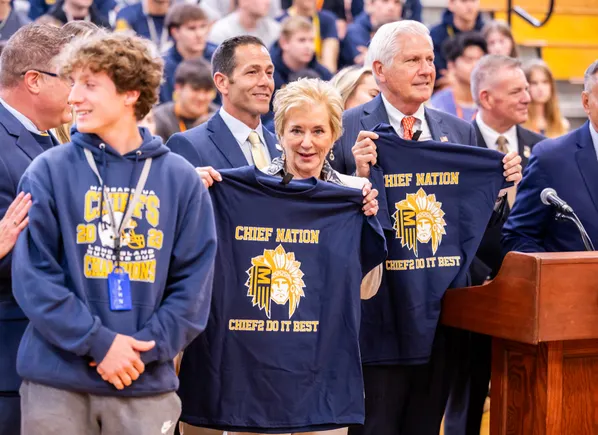
After a three-year journey that was sometimes difficult, Deer River Schools in Minnesota ultimately received official approval for its mascot from the local Native American tribe in just a few minutes.
The Leech Lake Band of Ojibwe council — the tribe with the largest number of American Indian students in the Deer River district — approved the district's spear and feather design on July 16. This approval was based on a 2025 amendment to a Minnesota law that allows school districts to retain or adopt American Indian imagery or names after obtaining formal consent from tribal nations.
"This decision reflects the value of cooperation and respects the intent of the law, which rightly recognizes the importance of tribal sovereignty and local relationships," said Leech Lake Band of Ojibwe Chairman Faron Jackson Sr. in a statement on July 18.
On the same day, the council also approved the use of a Native American-themed mascot by Grand Rapids Area Schools, which is adjacent to the Deer River district. "We appreciate that both school districts engaged with us in good faith and demonstrated a genuine commitment to supporting American Indian students and respecting our culture," Jackson said.
However, the journey to this outcome was far from smooth.
Deer River Schools' previous mascot featured the image of a Native American man. But in 2023, Minnesota enacted a law requiring school districts to obtain approval from all 11 federally recognized tribes in the state when using Native American mascots.
"Things happened quickly, and it was really confusing for those of us affected," said Pat Rendle, superintendent of Deer River Schools. "That was a very difficult process."
This year, state lawmakers revised the law to simplify the process. Now, school districts only need approval from their American Indian Parent Advisory Committee and a primary tribal partner to use Native American mascots.
"As a school leader, I just did what was asked day by day, step by step, and remained patient," Rendle said. "In the end, the outcome was as it should have started — but it took about three years to get there — which is letting us decide these matters at the local level."
A controversy both old and new
Minnesota's evolving approach to when it is appropriate to use Native American mascots in K-12 public schools, and the eventual outcome for Deer River Schools, reflects a broader debate brewing nationwide: When, if ever, does using or banning Native American mascots constitute racial discrimination? Who decides what mascots should be? Who should pave the way for approval — local, state, federal government, or other entities?
In recent months, the U.S. Department of Education under the Trump administration — and President Donald Trump himself — has reignited this debate.
While working to cut diversity, equity, and inclusion measures aimed at making schools more culturally reflective of students from various ethnic backgrounds, the Trump administration has on the other hand pushed to restore Native American mascots, arguing that banning them constitutes discrimination based on race and ethnic origin.
In April, the Department of Education's Office for Civil Rights launched an investigation into the New York State Education Department over a local dispute with the Massapequa School District regarding its "Chiefs" mascot. The district had fought in court to keep its mascot after the state banned Native American mascots in 2023, with certain exceptions.
Like Minnesota, school districts were required to obtain consent from local tribes to use Native American imagery. This was based on a New York State Education Department policy aimed at preventing insensitive representations of Native American culture.
However, by the end of May, the Trump administration determined that New York State violated Title VI of the Civil Rights Act, which prohibits discrimination based on race, color, or national origin in programs receiving federal funding, because the state banned school districts from using Native American mascots and symbols. By mid-June, after New York refused to sign the administration's proposed settlement, the case was referred to the U.S. Department of Justice for enforcement.
The rejected settlement would have overturned state regulations banning Native American mascots in New York public schools, issued memos to all school districts notifying them of the change, and sent apology letters to Native American tribes to remedy discrimination against American Indians.
"The Trump administration will not sit by while state leaders try to erase the history and culture of Native American tribes," U.S. Secretary of Education Linda McMahon said in a statement on May 30. "Instead of focusing on learning outcomes, the New York State Education Department and Board of Regents are focused on erasing Massapequa's history — while turning a blind eye to mascots in other districts that originate from or are related to other racial or ethnic groups."
In July, the Office for Civil Rights launched a second investigation into New York State's Connetquot Central School District over its "Thunderbird" mascot.
"Images like the Thunderbird and Chiefs are seen as symbols of strength, honor, and identity — not disrespect," McMahon said in a statement on July 8. "The Department of Education has made it clear to New York State: banning Native American mascots and symbols while celebrating European and other cultural imagery is neither legal nor correct. New York's paternalistic attitude toward Native Americans must end."
That investigation is still ongoing.
The Department of Education's push to restore Native American mascots and characterize their bans as discrimination reflects Trump's broader efforts beyond K-12. The president recently threatened to veto a municipal stadium deal if the NFL's Washington Commanders do not restore their long-controversial "Redskins" name.
What research says
Although the Department of Education has clearly taken a side in this debate, some research points in the opposite direction.
Nearly two decades ago, the American Psychological Association (APA) called on schools and other institutions and organizations to immediately withdraw all American Indian mascots, symbols, images, and figures. The organization cited social science research on the negative impact of racial stereotypes, especially through mascots, on the identity development and self-esteem of young American Indians.
"We know from the literature that oppression, covert and overt racism, and perceived racism can have serious negative consequences for the mental health of American Indians and Alaska Natives," said Lisa Thomas, then-chair of the APA's Committee on Minority Affairs, in a statement on the organization's website. "Ending the use of American Indian mascots is a gesture indicating that this racism and disrespect toward all people in this country and the broader global context will not be tolerated."
The APA cited research by Stephanie Fryberg, a member of the Tulalip Tribes and a social and cultural psychologist. Research shows that American Indian mascots are harmful because they are often negative and remind American Indians of "the limited ways others see them."
"This in turn limits the way American Indians see themselves," she said. Fryberg is a professor at the University of Arizona who studies the impact of racial and cultural representations on mental health, development, and educational achievement.
In 2011, Fryberg testified on behalf of the APA before the Senate Committee on Indian Affairs, summarizing her own and others' research: American Indians who were exposed to mascots allegedly representing them reported lower self-esteem and sense of community value, reduced achievement-related aspirations, and higher rates of anxiety and depression. In contrast, European Americans reported increased self-esteem after exposure to American Indian mascots.
"Consistent with the stereotype literature, American Indian mascots are among the features of everyday life that are taken for granted, and they contribute to racial and ethnic inequality in this country," Fryberg said.
Nuance
Meanwhile, Native Americans themselves are divided on the mascot issue.
"We believe that if people view American Indians as objects of respect and reverence, that is a badge of honor," said Mark OneWolf, associate board member of the Native American Guardians Association.
The association advocates for the "respectful use" of Native imagery in sports and education and filed the civil rights complaint that triggered the Department of Education's Title VI investigation into the Massapequa School District's "Chiefs" mascot in New York.
If a school district wants to honor a local tribe, OneWolf said, it is important to represent that tribe correctly. For example, OneWolf is Apache, and he recalled a school district whose mascot was "Apaches" but used imagery of Plains Indians (typically from the Great Plains of North America), while Apaches are from the Southwest.
"If a different culture is used, I don't think that is honoring Apaches," OneWolf said. "It's like if I said I want to honor Chinese people, but I put up a picture of a Japanese samurai or something similar."
OneWolf said he has reservations about wearing mascot costumes, including the use of face paint or feathers, at events such as game days.
"Everything we do has meaning — feathers have meaning, face paint has meaning, the colors of the paint have meaning," he said. "So when people wear costumes, those meanings cannot be conveyed."
In Minnesota's Deer River Schools, about one-third of students are American Indian or Alaska Native, according to U.S. News & World Report. Finalizing the mascot required ongoing conversations with Native students and families. Before the tribal council approved the mascot, district representatives presented the history of its mascot and highlighted their efforts to ensure respectful representation, including soliciting input from stakeholders.
Before granting final approval, tribal leaders reviewed these materials and community engagement efforts.
However, others believe Native American mascots should not be used at all, or should be limited to schools primarily serving Native students.
"These symbols perpetuate harmful stereotypes and contribute to hostile school environments for Native students," the National Indian Education Association (NIEA) said in a statement to K-12 Dive.
In 2013, NIEA passed a resolution calling for the elimination of such mascots nationwide, but supported the right of tribal nations and Native-led schools to use cultural imagery to reflect their own traditions. For example, Minnesota's law aimed at banning Native imagery automatically exempts schools located on tribal reservations with student populations at least 95% American Indian.
"There is a meaningful difference between Native nations choosing to represent themselves, using images or names that reflect their own communities, and non-Native institutions using racist terms or stereotypes to entertain crowds," said the Native American Rights Fund. The statement was made in response to the Department of Education's New York Title VI findings in July, which the organization called "seriously flawed."
"The former is cultural expression; the latter is cultural mockery," the organization said.
Who decides?
By enforcing Title VI to support the use of Native American mascots, the Trump administration — which otherwise pushes for state and local control on K-12 issues — is steering a matter many view as a local decision.
"While federal involvement in this issue reflects increased awareness of its impact on Native students, we believe meaningful change must be rooted in the voices and leadership of Native communities," NIEA said in its statement to K-12 Dive. "Political efforts — especially without tribal consent — to retain or restore these mascots run counter to that goal."
According to Lutzker & Lutzker, a law firm providing trademark and branding legal services, as of April 2023, more than 21 states had taken action or were working to address the use of Native American mascots in their public schools. At that time, the firm said 1,901 schools in 966 districts still used Native-themed mascots.
These efforts also carry financial implications for school districts.
In guidance New York State issued to school districts in 2023 for making mascot changes to comply with the state ban, the state urged districts to take the least costly path where possible. "For example, instead of replacing an entire artificial turf field, only replace the center section containing the prohibited team, logo, or image," the state said in a FAQ. The state also offered assistance to subsidize costs.
In Minnesota, if Deer River Schools had not applied for an exemption, fully replacing the mascot under state law would have cost about $300,000 to rebrand uniforms and other school supplies.
"We are making significant budget cuts. If we had to do something to our brand, that would be a bit absurd," Rendle said. He added that he does not think policymakers understand the impact of such a large-scale change on a school district.
"We want to mind our own business," Rendle said. "Sometimes these things that pop up have nothing to do with your own community, but rather with someone else's views on what should happen statewide or even nationwide."


